
Permanent Outdoor Lighting Sparta NJ: Smart Winter Investment

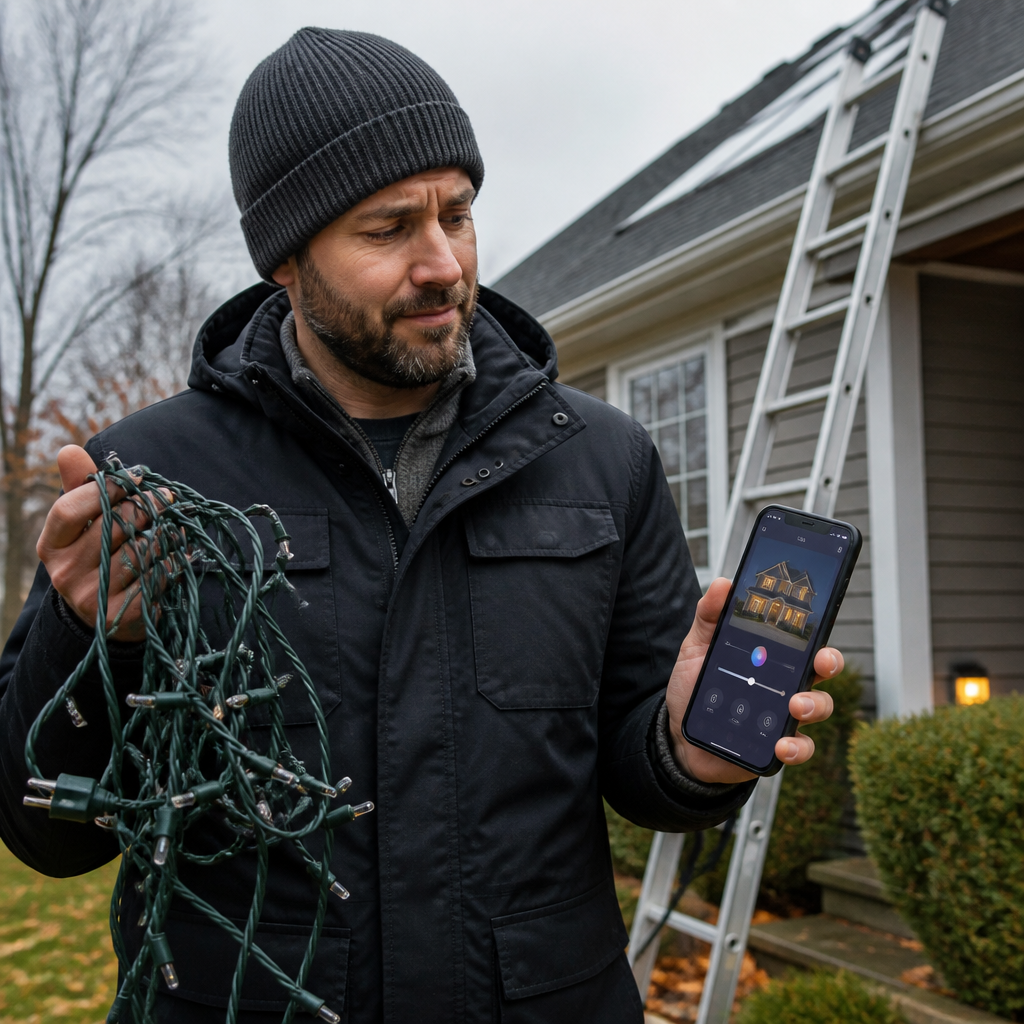
Every October, thousands of North Jersey homeowners drag out tangled extension cords, balance on ladders in cold weather, and spend an entire weekend hanging lights they will take down in January. If that describes your routine, there is a better path. Permanent outdoor lighting in Sparta, NJ replaces that annual ordeal with a single professional installation that lives on your roofline and fascia year-round, controlled entirely from your phone. For Sparta homeowners specifically, the math is straightforward: Sussex County winters arrive early, the freeze-thaw cycle is punishing, and a ladder on an icy roof is a genuine safety hazard. Installing a permanent system before winter is not just more convenient, it is the smarter financial decision.
Table of Contents
- Quick Takeaways
- What Is Permanent Outdoor Lighting, Exactly?
- Why Install Before Winter in North Jersey?
- The Real Benefits for Sparta Homeowners
- How Much Does It Cost? What Sparta Homeowners Pay
- Lighting Systems Compared: Choosing the Right One
- What the Installation Process Actually Looks Like
- Frequently Asked Questions
- References
Quick Takeaways
|
Key Insight |
Explanation |
|---|---|
|
Install once, skip the ladder forever |
Permanent systems mount to fascia or eaves and stay there year-round. No seasonal hanging, no removal, no storage headaches. |
|
Sparta winters make October the right window |
Sussex County freeze-thaw cycles begin in late fall. Getting a crew on your roofline in October avoids icy conditions and scheduling delays. |
|
App control covers every occasion |
Change colors and patterns instantly for Christmas, Halloween, the Fourth of July, or a quiet warm-white evening setting, all from your phone. |
|
Most systems break even in 3 to 5 years |
When you factor in what you currently spend on seasonal installation, removal, and replacement bulbs, permanent lighting typically pays for itself within a few seasons. |
|
Surface prep before installation extends LED life |
Dirty or algae-covered fascia shortens adhesion life. A professional who handles both cleaning and installation ensures the track bonds correctly from day one. |
|
Weather-rated components are non-negotiable in NJ |
Quality permanent systems use IP65 or higher rated fixtures and sealed wiring to handle rain, snow, and temperature swings without failing. |
|
Permanent lighting adds measurable curb appeal |
Appraisers and real estate professionals in competitive North Jersey markets consistently note that quality exterior lighting improves perceived property value. |
What Is Permanent Outdoor Lighting, Exactly?
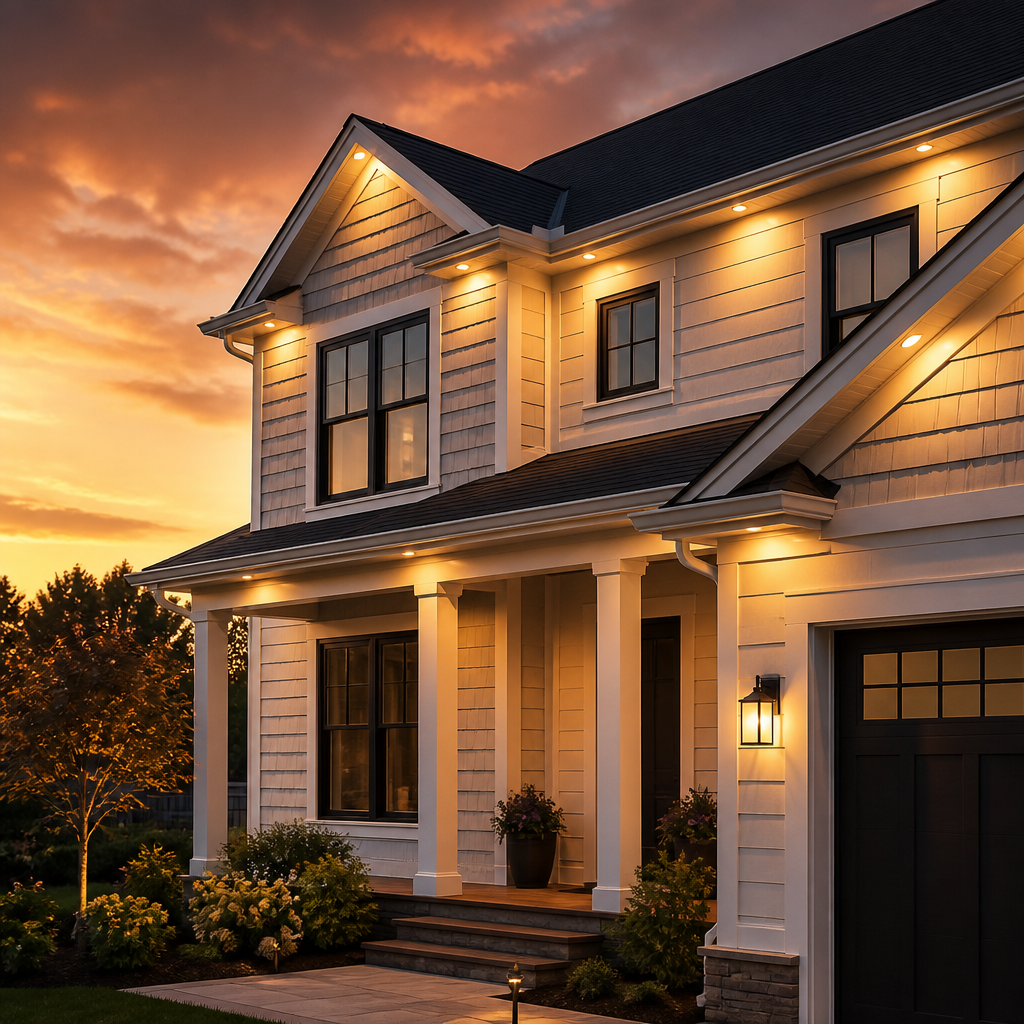
Permanent outdoor lighting refers to a professionally installed, weatherproof LED system mounted directly along the roofline, fascia, eaves, or architectural trim of your home. Unlike temporary holiday strings that clip on and come off every season, these lights live in low-profile aluminum or polymer tracks that are fastened to your home’s structure and wired to a dedicated controller. During daylight hours, the tracks blend into your trim so cleanly that most visitors do not notice them. At night, one tap on a smartphone app brings the entire display to life.
The core technology is individually addressable LEDs, meaning each bulb along the track can display its own color independently. That is what makes effects like chasing patterns, fading gradients, and zone-specific holiday themes possible. Popular platform systems used by professional installers across North Jersey include options like Govee, Gemstone, and Minleon, each offering smartphone-based scheduling, pre-built holiday presets, and millions of color combinations.
Pro tip: Ask your installer whether the controller supports scheduling by sunset trigger rather than a fixed time. In Sparta, sunset shifts by more than three hours between summer and winter. Sunset-triggered automation means your lights come on consistently without you ever adjusting the schedule manually.
Why Install Before Winter in North Jersey?
The timing question matters more in Sparta than it does in most of the country. North Jersey winters are not gentle. Sussex County sits in the highlands of northwestern New Jersey, where temperatures drop faster, the first frost comes earlier, and snowfall totals often exceed those of communities further south and east. By November, roofline work becomes considerably more complicated for any crew.
The Safety Argument for an October Install
Every year, emergency rooms across the country treat thousands of homeowners who fell from ladders while hanging holiday lights. An October installation in Sparta happens before the freeze-thaw cycle sets in, before rooftops are wet with early morning frost, and before daylight hours shorten to the point where crews are working in poor visibility. Getting the job done in October is simply safer for everyone involved.
Availability and Scheduling Reality
Reputable exterior lighting installers in North Jersey fill their November and early December schedules quickly. Homeowners who call in mid-November often find that the first available appointment is after Thanksgiving, which defeats the purpose of having the system ready for the holiday season. Booking in October gives you first pick of installation dates and gives the installer adequate time to do the job properly without rushing.
One System, Every Holiday from Day One
When you install in October, the system is live for Halloween, Thanksgiving, Christmas, and New Year’s all in the same season. That is the full holiday run handled with zero additional effort after installation day. Most homeowners who experience their first winter with permanent lighting report that they cannot imagine going back to temporary strings.
“Permanent lighting eliminates the dangerous annual ritual of climbing ladders on icy roofs. Install once, control from your phone year-round.”
The Real Benefits for Sparta Homeowners
The benefits go well beyond holiday convenience. Here is how permanent outdoor lighting specifically serves Sparta and North Jersey homeowners throughout the entire year.
Security and Safety After Dark
Sparta’s lake communities and wooded neighborhoods have long driveways and deep setbacks from the street. A dark house in that context is an invitation to opportunists. Permanent lighting lets you schedule a warm-white accent mode that keeps your roofline, entry points, and driveway perimeter visible every night. Well-lit properties are consistently cited as a deterrent to intrusion because visibility removes the cover that criminals depend on.
Year-Round Curb Appeal Without Lifting a Finger
You can set a subtle warm white for everyday use in January, switch to red and green for Christmas week, go orange and purple for October, and back to a clean neutral tone for spring, all from your phone. The display changes in seconds. For homeowners in Lake Mohawk and surrounding Sparta neighborhoods where curb presence matters, this is a genuine differentiator.
Property Value in a Competitive Market
Quality exterior lighting is one of the few home upgrades that is visible to every visitor, buyer, and appraiser who approaches your property. Real estate professionals in North Jersey consistently note that well-executed exterior illumination improves perceived value and makes homes more memorable to prospective buyers. In a market where comparable homes compete for attention, a professionally installed permanent lighting system is a detail that registers.
Pro tip: If your home has distinctive architectural features, such as a gabled roofline, a wraparound porch, or a stone facade, work with your installer to zone the lighting so those features are highlighted specifically. Cookie-cutter roofline runs are fine, but systems that complement your home’s actual architecture look far more intentional and polished.
Energy Efficiency Compared to Traditional Holiday Lights
Modern permanent LED systems draw a fraction of the electricity that older incandescent holiday light strings consume. Running a full roofline of energy-efficient LEDs night after night costs considerably less than running old-style C9 bulbs for even a few weeks during the holiday season. Over the lifetime of the system, the energy savings compound meaningfully.
How Much Does It Cost? What Sparta Homeowners Pay
The most common question homeowners ask before committing is about price. Permanent outdoor lighting is a real investment, and you deserve honest numbers rather than vague ranges that tell you nothing.
Based on verified installer pricing data for the North Jersey and broader NJ market, permanent outdoor lighting typically runs between roughly $16 and $40 per linear foot installed, with total project costs for a typical single-family home landing between approximately $2,500 and $6,000. Larger homes or those with complex, multi-gabled rooflines can run higher.
What Drives the Price Up or Down
The three biggest cost variables are the linear footage of roofline being covered, the tier of LED system selected, and the complexity of the installation. A straightforward ranch-style home with a simple roofline costs less per foot than a two-story colonial with multiple gable returns, dormers, and detailed trim work. System tier matters too: entry-level RGB systems cost less per foot but produce less accurate whites and have simpler controllers, while premium systems offer millions of colors, better warm-white quality, and more sophisticated app experiences.
The Break-Even Case
Sparta homeowners who currently pay for seasonal installation and removal of temporary holiday lights typically spend somewhere between $300 and $800 per year on that service, not counting the cost of bulb replacement or storage. When you run that number out over five years, permanent lighting at most reasonable price points breaks even within three to five seasons and continues paying dividends in saved time and hassle every year after that.
Lighting Systems Compared: Choosing the Right One
Not all permanent outdoor lighting systems are the same. The right choice depends on how you plan to use the lights, how important color accuracy is to you, and what level of smart-home integration you want.
|
System Tier |
Best For |
Key Trade-Off |
|---|---|---|
|
Entry-Level RGB (approx. $15-18/ft) |
Homeowners primarily focused on holiday colors and basic seasonal displays with a tighter budget |
Limited white-light quality makes everyday neutral accent lighting look slightly off; controller apps tend to be more basic |
|
Mid-Tier RGBWW (approx. $20-28/ft) |
Homeowners who want both vivid holiday colors AND a clean, usable warm white for year-round accent lighting |
Higher upfront cost, but far more versatile for daily use; typically includes scheduling, zoning, and voice-assistant compatibility |
|
Premium Architectural (approx. $30-40/ft) |
High-end homes where the lighting must integrate seamlessly with architecture and where color accuracy and longevity are priorities |
Highest upfront investment; requires a skilled installer to maximize the system’s capabilities and placement precision |
For most Sparta homeowners, the mid-tier RGBWW category hits the best balance. It gives you the holiday display capability you want in December while also functioning as tasteful, warm accent lighting in January, March, and August without looking garish. Entry-level systems are tempting on price, but homes in Lake Mohawk and surrounding neighborhoods often have enough architectural character that a slightly better system pays off visually.
What the Installation Process Actually Looks Like
A common misconception is that permanent lighting installation is a quick plug-and-play job. A professional installation is methodical, and the quality of each step affects how long the system performs and how good it looks.
Surface Preparation Comes First
This is the step that separates a lasting installation from one that starts peeling or losing adhesion within a year. Fascia boards and eaves in North Jersey accumulate dirt, algae, oxidation, and chalky paint residue over time. Tracks and mounting hardware bonded to a dirty or deteriorating surface will not stay put. Before any light track goes up, the mounting surfaces need to be cleaned and, where necessary, treated. At Flow State Pressure Washing, this is built into our process because we bring both the exterior cleaning expertise and the lighting installation knowledge to the same job. The result is a system that bonds correctly from day one.
Track Mounting and Wiring
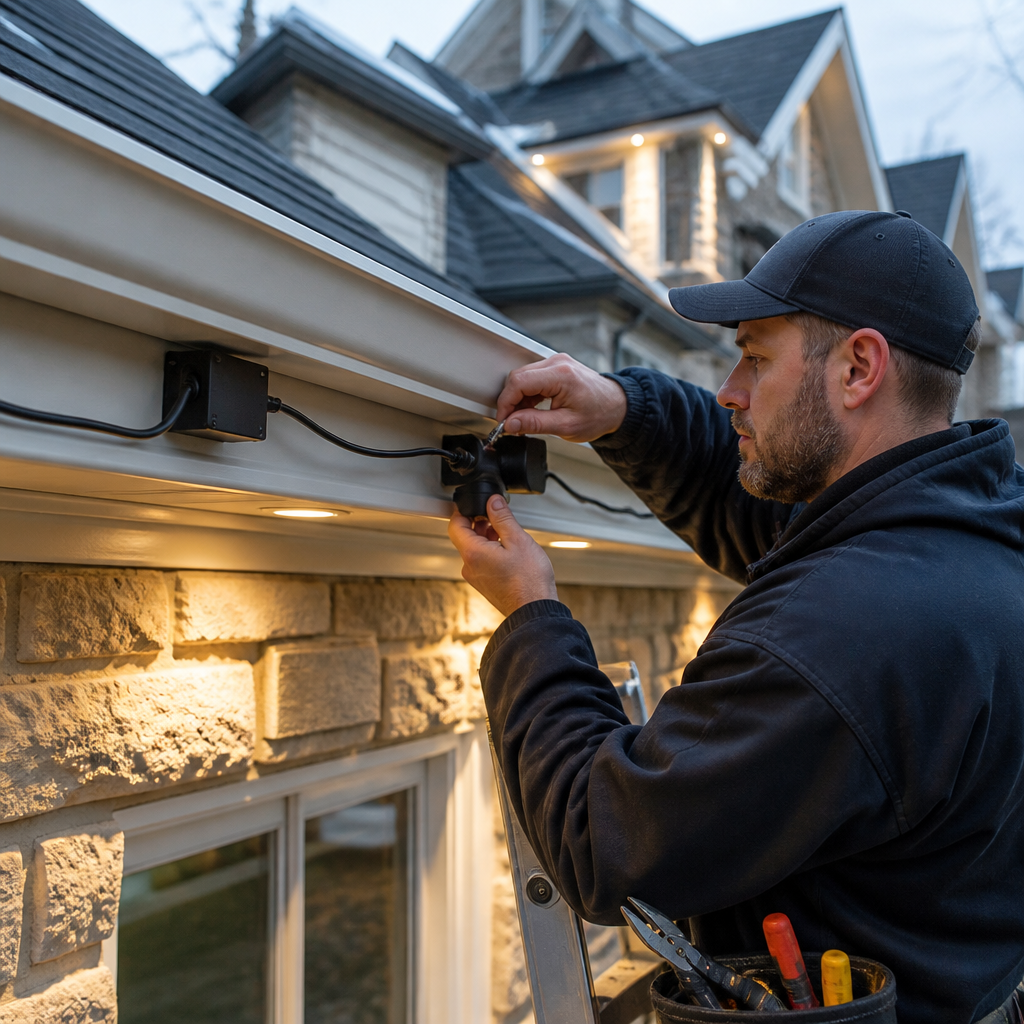
The tracks are fastened along the fascia or under the eave, following the roofline precisely. Wiring runs through channels or behind trim to stay hidden from view. A professional installer plans the wire routing before a single fastener goes in so that the finished product looks intentional rather than improvised. Power connections are made to a weatherproof controller box, typically mounted in a garage or protected exterior location.
Controller Setup and App Configuration
Once the hardware is in place, the system is paired to its controller and the homeowner’s smartphone. A good installer walks you through zone setup, preset programming, and scheduling before leaving the job site. Most professional-grade systems also allow for future zone additions or system expansion if you decide to extend coverage to a detached garage, deck railing, or landscape features later.
Most residential installations on single-story Sparta homes take one to two days for a professional crew. More complex rooflines or larger properties may require additional time, but your installer should be able to give you a clear timeline at the estimate stage.
Frequently Asked Questions
Yes, provided the system uses properly rated components. Quality permanent lighting fixtures carry an IP65 or IP67 weather resistance rating, which means they are sealed against water ingress, driving rain, and ice. The tracks themselves are typically aluminum or impact-resistant polymer. Systems installed by a professional using weatherproof hardware and sealed wiring connections routinely handle North Jersey freeze-thaw cycles, ice storms, and heavy snow loads without issue. An entry-level system with substandard waterproofing is a different story, which is exactly why component quality matters more than upfront price alone.
No, permanent LED lighting systems require a live power connection to operate. During an outage, the system will be off. However, most controllers retain your saved presets, schedules, and zone configurations in memory, so when power is restored, everything picks up exactly where it left off without you needing to re-program anything.
The lights themselves are largely maintenance-free once installed. LEDs have rated lifespans measured in tens of thousands of hours, so bulb replacement is not a regular concern. The one maintenance task worth doing annually is a light cleaning of the track and lens surfaces, particularly in Sparta where pollen, tree sap from surrounding woodlands, and algae spores can accumulate on exterior surfaces. A professional exterior cleaning visit keeps the fixtures looking crisp and ensures the lenses are clear for maximum brightness.
Most roofline styles, including ranches, colonials, Capes, Craftsman homes, and contemporary builds, are compatible with permanent lighting systems. Complex rooflines with multiple gable returns, dormers, or unusual angles take longer to plan and install, but they are not obstacles to a professional crew. The planning phase of a good installation involves walking the roofline with the homeowner, identifying every run length, all corner transitions, and any architectural features worth highlighting. That walkthrough is where you catch any complications before they become surprises on installation day.
In many cases, yes. Most permanent lighting systems offer a clean, neutral warm-white mode that is virtually indistinguishable from traditional architectural accent lighting. If your HOA governs holiday displays, the key point to clarify with the association is that permanent lighting in warm-white mode functions as standard architectural illumination, not a seasonal decoration. Bring photos of the system in its daytime profile, when the low-profile tracks blend into the trim, as well as examples of the warm-white nighttime mode. The more polished and architectural the system looks, the easier the HOA conversation typically becomes.
Landscape and path lighting illuminate the ground level, driveways, and garden features. Permanent roofline lighting illuminates the structure itself, following the architectural lines of the home from the top down. The two systems serve different visual purposes and can complement each other very effectively. Roofline lighting draws the eye to your home’s silhouette and creates a dramatic nighttime presence from the street. Ground-level landscape lighting adds depth and fills in the middle and lower zones of your property. Many homeowners in Sparta install both over time, starting with the roofline and adding ground-level elements later.
Have you already made the switch to permanent outdoor lighting, or are you still weighing the decision? Share your experience or questions below, and we will do our best to help you figure out the right next step for your Sparta home.
References
-
Permanent outdoor lighting market data and cost ranges for Sparta, NJ homeowners
-
Complete 2026 price guide for permanent outdoor lighting installation costs per linear foot
-
Permanent LED lighting cost breakdown and ROI comparison versus annual temporary lights
-
Benefits of permanent roofline lighting: architectural integration, curb appeal, and property value
-
Flow State Pressure Washing permanent exterior LED house lighting installation project in Sparta, NJ
Ready For A Clean Home?
Schedule Quality Sparta Power Washing Today!