
Commercial Christmas Light Installation: ROI Guide for NJ

Property managers in North Jersey already have a long list of vendor decisions to make every quarter. Commercial Christmas light installation rarely gets the strategic attention it deserves, and most managers treat it as a line-item expense rather than a revenue-adjacent investment. That is a mistake. A professionally designed and installed holiday lighting display on a retail strip, apartment complex, or commercial campus does measurable work: it drives evening foot traffic, signals attentive property management to tenants and prospects, and in the case of permanent LED systems, eliminates a recurring annual labor cost within just a few seasons. This guide breaks down exactly what that investment looks like, what it returns, and how to make the right decision for your North Jersey property.
Table of Contents
- Quick Takeaways
- Why Commercial Holiday Lighting Is an ROI Decision
- What Commercial Christmas Light Installation Costs in North Jersey
- Seasonal vs. Permanent LED Lighting: The Real Comparison
- How Holiday Lighting Affects Tenant Retention and Foot Traffic
- What to Look for in a Commercial Installer in North Jersey
- Planning Timeline and Booking Deadlines
- Frequently Asked Questions
- References
Quick Takeaways
| Key Insight | Explanation |
|---|---|
| Commercial holiday lighting is an investment, not just decor | Professional displays improve evening foot traffic, tenant satisfaction, and leasing perception, all of which affect your net operating income. |
| NJ commercial projects range from $2,500 to $25,000+ | Scope, building size, number of structures, and lighting type determine cost. Mid-size retail and multi-building HOAs fall in the middle of that range. |
| Permanent LED systems typically pay back within 3 to 4 seasons | By eliminating recurring installation labor and storage costs, permanent roofline LEDs become less expensive than repeated seasonal installs over a multi-year horizon. |
| Commercial-grade LEDs outperform retail lights significantly | Professional LEDs are measurably brighter and maintain color consistency across every bulb in a strand, which matters for large facade coverage seen from the road. |
| Book your installation by September in North Jersey | Quality commercial installers in the region fill their November schedules fast. Properties that wait until October often get squeezed into inferior install windows or passed over entirely. |
| Lighting improves perceived property management quality | Well-lit facades and common areas send a direct signal to tenants and prospective lessees that the property is professionally managed and maintained year-round. |
| Removal and storage are often overlooked cost factors | A full-service commercial contract should include takedown and storage, or a permanent install that eliminates both. Factoring only the installation cost understates the true annual spend. |
Why Commercial Holiday Lighting Is an ROI Decision
Most property managers think about holiday lighting the way they think about landscaping mulch: it looks nice, it costs money, and someone has to do it. The framing is wrong. Outdoor lighting investment on commercial properties affects occupancy, lease rates, and appraised value in ways that are well documented in commercial real estate circles.
A well-lit property signals to tenants, customers, and buyers that the owner is attentive. That perception has a direct influence on negotiations, lease rates, and the length of time a listing remains on the market. Properties with uniform, professionally installed exterior lighting generally retain tenants longer because those tenants face fewer security complaints and see stronger evening traffic. Fewer tenant replacements mean more stable net operating income.
Holiday lighting is the seasonal version of that same principle applied at maximum visibility. During November and December, your property’s exterior is competing for attention at the exact moment when retail tenants most need foot traffic. A dark or generic facade tells the story that nobody is paying attention. A professionally lit one says the opposite.
Outdoor lighting is one of the most cost-effective commercial exterior upgrades because it simultaneously improves safety, extends usable evening hours, and communicates that a property is professionally managed. All three outcomes affect tenant retention and leasing velocity.
For apartment complexes and HOA-managed properties in North Jersey, the calculation is slightly different but equally valid. Residents choose communities partly on aesthetics and perceived safety. A property that invests in quality seasonal lighting, and then upgrades to permanent LEDs that display color-changing sequences year-round, creates a community identity that supports both retention and referral.
What Commercial Christmas Light Installation Costs in North Jersey
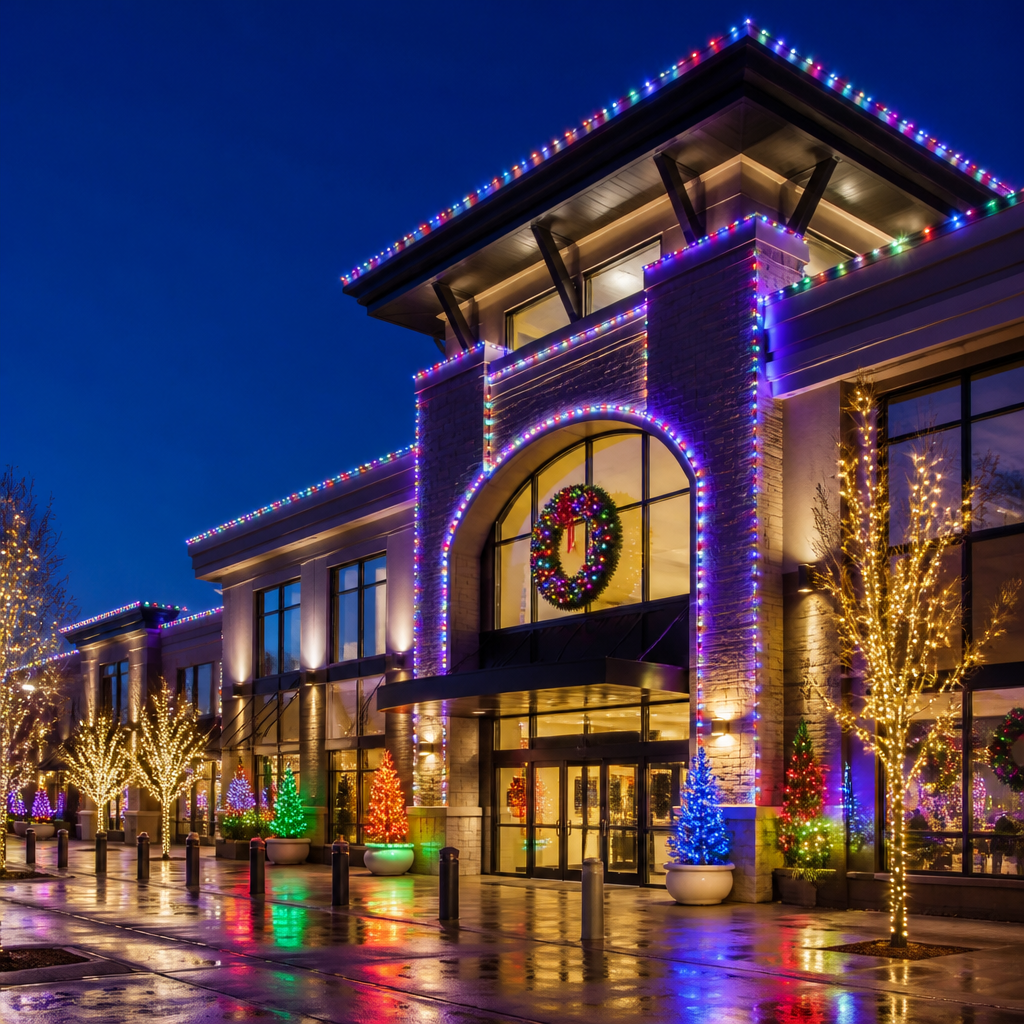
Pricing in the commercial segment varies widely, but the range is not a mystery. New Jersey commercial Christmas lighting projects run from roughly $2,500 on the low end for a small retail storefront or single building facade, up to $25,000 or more for multi-building complexes, large HOA community entrances, and custom landscape-integrated displays.
Cost Factors That Move the Number
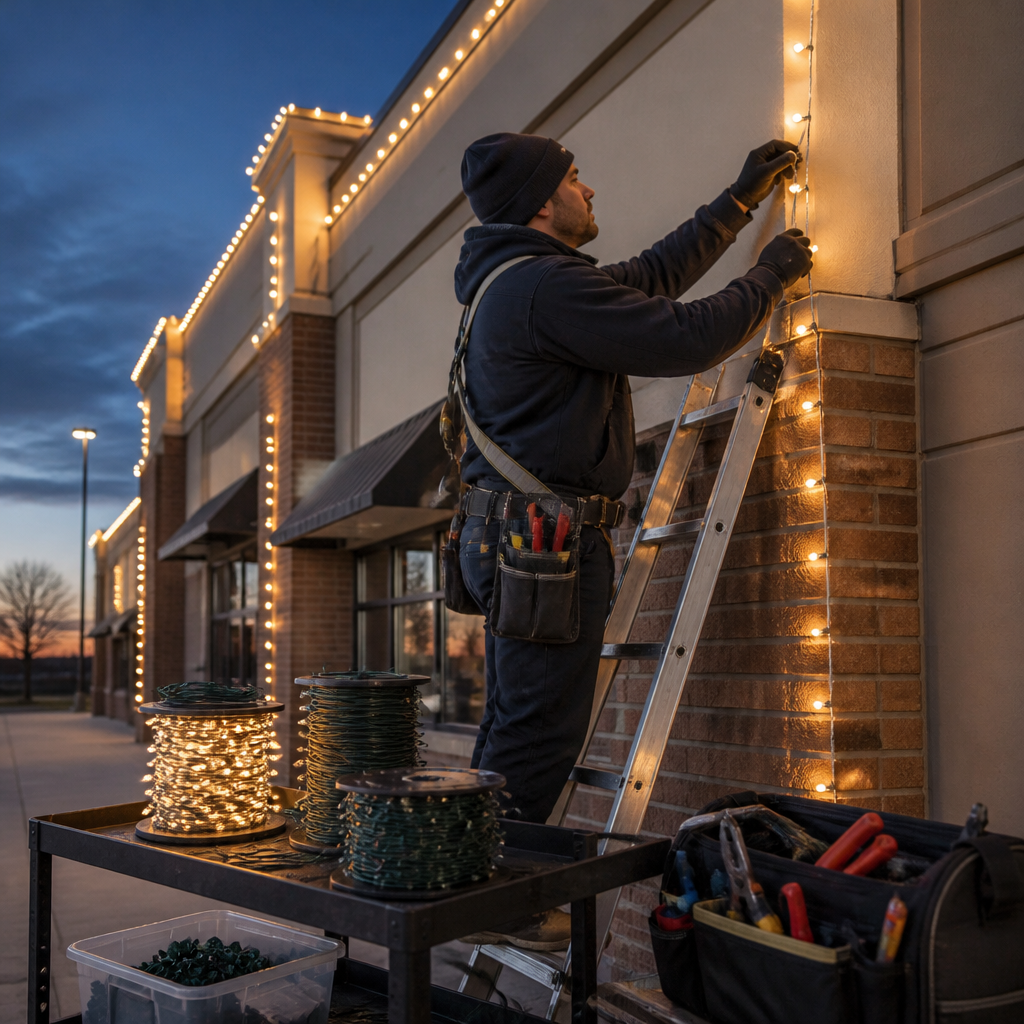
Linear footage is the primary pricing unit for most commercial installs. Professional installers in the region typically charge by the foot for both materials and labor, with commercial-grade projects priced higher per foot than residential work because of equipment requirements, safety protocols for taller structures, and the quality of components used. Lighting service professionals commonly charge $50 to $75 per hour for labor, with minimum service fees that make very small scopes economically inefficient at commercial-grade quality.
Multi-story buildings, steep rooflines, and properties that require lift equipment or scaffolding carry additional labor premiums. For apartment complexes with multiple buildings, pricing scales with the number of structures, total linear footage of rooflines and common areas, and whether landscape features like trees and pathways are included.
What Is and Is Not Included in a Commercial Quote
A proper commercial holiday lighting quote should include installation, the lights themselves (commercial-grade, not retail), takedown after the season, and storage if applicable. Many property managers make the mistake of comparing quotes that bundle different scopes. A quote that excludes takedown looks cheaper until January arrives. Always ask whether removal is included and whether the lights are stored by the installer or returned to the property.
Pro tip: Ask your installer to provide itemized quotes that separate materials, installation labor, takedown labor, and storage. This makes year-over-year budget comparisons accurate and gives you leverage if you decide to switch to a permanent LED system, because you will know exactly what recurring costs you are replacing.
Seasonal vs. Permanent LED Lighting: The Real Comparison
This is the decision most commercial property managers in North Jersey face once they have done seasonal installation for two or three consecutive years. The upfront cost of permanent systems looks steep until you do the multi-year math, which is where the ROI becomes clear.
| Approach | Upfront Cost | Annual Recurring Cost | Best For |
|---|---|---|---|
| Seasonal Professional Installation | Low ($2,500 to $7,500 per season for mid-size commercial) | Full cost repeats every year, including labor, takedown, and storage | Properties that want display flexibility, new designs each season, or are testing the investment before committing |
| Permanent LED Roofline System | Higher ($3,000 to $15,000+ installed, with permanent per-foot costs running $18 to $35 per linear foot) | Near-zero after installation. No seasonal labor, no storage, no annual rehire | Properties committing to multi-year exterior investment, year-round color control, and maximum long-term ROI |
| Hybrid: Permanent Base + Seasonal Add-ons | Moderate to high depending on scope | Reduced annual cost because roofline and soffit lighting is already handled; only accent elements require seasonal install | Large commercial campuses and HOA communities that want a permanent foundation with seasonal customization on top |
Permanent LED systems have a rated lifespan that, at typical commercial run hours, translates to decades of use. The one-time investment replaces a cost that would otherwise recur every single season. Properties that run the three-year calculation almost always find that the permanent system is less expensive in total cost by year four, and that is before accounting for the year-round utility of a system that can display brand colors, seasonal palettes, or event lighting on any given evening.
Pro tip: For apartment complexes and HOA-managed communities in Sparta and across North Jersey, permanent color-changing LED systems offer something seasonal installs cannot: year-round identity. A community entrance that changes its lighting palette for holidays, seasons, and community events creates a visual presence that supports resident pride and reduces turnover.
How Holiday Lighting Affects Tenant Retention and Foot Traffic
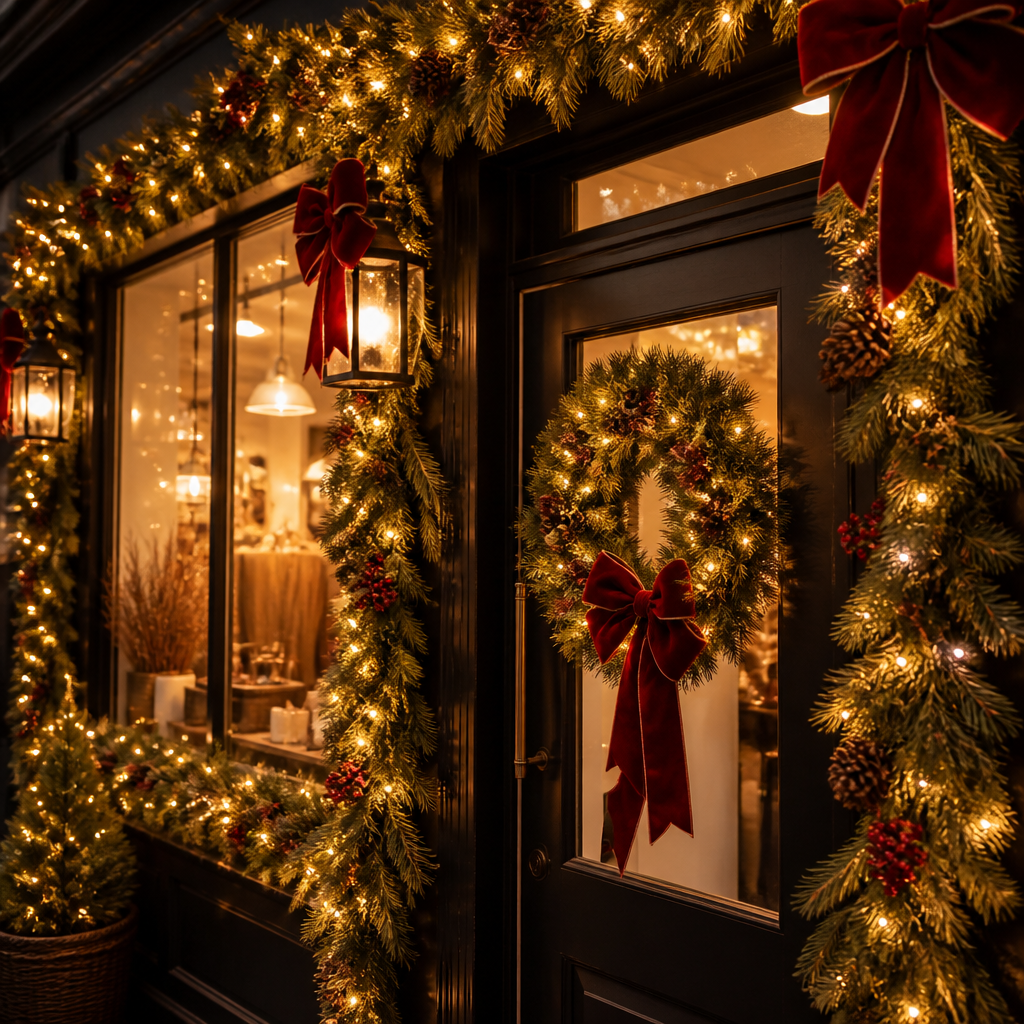
The retail holiday season is the most commercially compressed period of the year. During November and December, physical retail traffic surges on key weekends and in the final days before Christmas. A commercial property that is visually compelling in the evening captures a disproportionate share of that foot traffic compared to one that is dark or underlit.
For property managers overseeing retail strips, shopping centers, or mixed-use buildings in North Jersey, this matters in two ways. First, it supports your retail tenants’ revenue during their highest-volume period. Second, it demonstrates to those tenants, and to prospective tenants evaluating the property for leasing, that the property management team invests in the environment. Both effects directly support retention.
The Multifamily and HOA Angle
For apartment complex managers, holiday lighting serves a different but equally measurable purpose. A large share of prospective resident tours happen in the evening hours. A property that looks polished and inviting after dark performs better in that leasing window than one that relies entirely on daylight appeal.
Existing residents notice when a community invests in its appearance during the holidays. Well-lit common areas, building entrances, and community features communicate that management cares about the living environment. This perception reduces the friction that leads to non-renewal, which is one of the most expensive outcomes a multifamily property can face.
The Safety Perception Factor
One aspect of commercial lighting ROI that is often undersold is safety perception. A well-lit facade and parking area that feels navigable and safe at 9 PM keeps tenants and customers comfortable returning after dark. This is especially relevant for North Jersey properties where evening hours in late November and December arrive early, by 4:30 PM. Properties that fail to address the after-dark environment effectively shorten the functional retail and residential day for everyone who uses them.
What to Look for in a Commercial Installer in North Jersey
Not every exterior cleaning and lighting company has the equipment, insurance, or process to handle a commercial property correctly. This is one area where the difference between a residential-focused installer and a commercial-focused one becomes immediately obvious on-site.
Insurance and Licensing Requirements
Full commercial general liability insurance is non-negotiable for any installer working on your property. Property managers are exposed to significant liability if an uninsured installer is injured on site or causes property damage during installation on a roof, facade, or multi-story structure. Always request a certificate of insurance before any work begins, and verify that the coverage limits are appropriate for commercial work.
Equipment and Commercial-Grade Materials
Commercial LED installations require equipment that most residential operators simply do not carry. Lift equipment, commercial-grade ladders, and proper anchoring hardware for high-wind North Jersey winters are the baseline. The lights themselves matter equally. Commercial-grade LEDs are significantly brighter than retail-grade lights and maintain color consistency across every bulb in the strand. For a facade visible from the road, that consistency is the difference between a display that looks professional and one that looks assembled from a hardware store clearance bin.
Process and Consistency
Ask any installer you are considering how they document placement, wiring routes, and timer settings from one season to the next. A commercial installer with a real process will have installation diagrams, before-and-after photo documentation, and a clear procedure for identifying and replacing failed bulbs mid-season without waiting for a service call. In a commercial context, a dark section of roofline for three weeks in December is a problem, not an inconvenience.
Pro tip: Request references from other commercial or multi-family property managers, not homeowners. The scale, liability exposure, and consistency expectations of commercial work are different enough that a residential reference tells you almost nothing useful about how an installer performs in your context.
Planning Timeline and Booking Deadlines
This is the section most property managers wish they had read in July. Commercial holiday lighting in North Jersey operates on a tight seasonal calendar, and quality installers book out faster than most property managers expect.
The September Booking Window
Professional commercial installers in the region typically fill their November installation calendars by mid-to-late September. Properties that approach the process in October frequently find that their preferred installer is already committed, which forces a choice between a lesser provider, a rushed installation, or skipping the season entirely. None of those outcomes serve the property or its tenants.
The practical planning timeline for a North Jersey commercial property looks like this: finalize the scope and budget decision in August, select your installer and sign a contract in September, and allow the installer to complete your installation during the first two weeks of November before the Thanksgiving traffic surge. Takedown is typically scheduled for the first or second week of January.
Permanent LED System Planning
If you are considering a permanent LED installation, the timeline is even more front-loaded. Permanent system installs involve custom hardware, structural anchoring, and often electrical work that requires planning well before the season begins. A decision made in October for a permanent installation is almost certainly a decision that will not be executed until the following year. For property managers who want permanent lighting active for a specific holiday season, the planning process needs to start no later than late spring or early summer of that year.
Multi-Year Contracts and Lock-In Advantages
Many commercial installers offer multi-year agreements that lock in pricing and guarantee installation windows. For property managers overseeing larger portfolios, these agreements reduce the annual rebidding process, stabilize budget line items, and ensure that your property is prioritized in the installer’s schedule before they are fully booked. The trade-off is reduced flexibility to change scope or providers year over year. For properties with stable footprints and no major renovation plans, multi-year agreements are generally advantageous.
Frequently Asked Questions
Commercial holiday lighting projects in New Jersey typically range from $2,500 to $25,000 or more depending on property size, number of buildings, total linear footage, and whether landscape elements like trees and pathways are included. Mid-size retail properties and single apartment buildings generally fall in the $2,500 to $7,500 range per season. Large multi-building complexes or properties with elaborate custom designs can exceed that significantly. Permanent LED roofline systems are priced as a one-time installation, commonly running $18 to $35 per linear foot, with the cost recovered over three to four seasons compared to recurring seasonal installs.
Commercial-grade LEDs are built for professional installation on larger structures and high-visibility applications. They are significantly brighter than retail lights, maintain consistent color across every bulb in a strand without fading or color drift, and are rated for durability in North Jersey’s winter weather conditions including wind, ice, and temperature swings. Retail-grade lights purchased at a home improvement store are designed for a single homeowner’s one-season use. On a commercial facade, the difference in appearance and longevity is immediately visible.
The right answer depends on your property type and planning horizon. Seasonal installation makes sense if you want design flexibility from year to year, are managing a property with variable footprint, or are evaluating the investment before committing long-term. Permanent LED systems make sense if your property has a stable roofline, you want year-round exterior lighting capability including color-changing options for branding and events, and you are willing to absorb a higher upfront cost in exchange for eliminating recurring seasonal labor and storage expenses. Most properties that run a three-to-four-year total cost comparison find permanent systems to be less expensive over that horizon.
Book by September at the latest. Quality commercial installers in North Jersey fill their November installation windows by mid-to-late September. Properties that wait until October frequently face limited availability, rushed installs, or being passed over in favor of already-contracted clients. If you are considering a permanent LED system, the planning process should begin even earlier, ideally in late spring or early summer, to allow time for custom hardware specification, electrical planning, and installation scheduling well before the holiday season begins.
A proper commercial contract should explicitly cover installation, the cost or source of the lights themselves, mid-season maintenance and bulb replacement, takedown at the end of the season, and storage if the installer is holding your lights for next year. It should also specify what happens if sections fail mid-season, the expected response time for service calls, and proof of commercial general liability insurance. Any contract that does not specify takedown and storage terms is leaving you exposed to additional costs and scheduling headaches in January.
Yes, specifically with permanent LED systems. Permanent color-changing LED roofline and soffit installations can display virtually any color palette on any schedule, controlled through an app. This means a shopping center can display brand accent colors year-round, shift to red and green for Christmas, white and blue for winter, or custom colors for community events and grand openings. For apartment complexes, this creates a year-round community identity that seasonal installations simply cannot replicate.
In practice, most commercial property managers split this across both categories, and that framing is more accurate than treating it purely as maintenance. The installation itself is a maintenance and property management expense. The foot traffic, tenant satisfaction, and leasing impression it creates are marketing outcomes. For properties where holiday lighting demonstrably supports retail tenant performance or leasing inquiries, making the case to allocate part of the cost to a marketing budget is entirely defensible, and it tends to make the expense easier to justify year over year.
Have you worked through the seasonal-versus-permanent decision for your North Jersey property? Share what drove your choice, because other property managers in the area are asking the same questions right now.
References
- New Jersey Christmas light installation cost breakdown and commercial pricing guide
- Commercial holiday lighting installation cost overview and seasonal vs. permanent comparison
- Permanent Christmas lights cost-per-year breakdown and long-term ROI analysis
- How outdoor lighting increases commercial property value and tenant retention
- Holiday foot traffic and retail real estate performance data for property managers
Ready For A Clean Home?
Schedule Quality Sparta Power Washing Today!